
Nigeria Opens Its Skies: Global Satellite Titans Join Race to Connect Africa’s Largest Market




With new permits issued to Amazon’s Kuiper, BeetleSat, Satelio, and SpaceX, Nigeria signals a bold leap into the era of space-based broadband.
By Maarifaah Editorial Desk
Nigeria’s commitment to becoming a digital hub got a major boost after it granted seven-year satellite licenses to Amazon’s Kuiper Systems, Israel’s BeetleSat (NSLComm), and Germany’s Satelio IoT Services, joining Elon Musk’s SpaceX in offering space-based broadband services.
The Nigerian Communications Commission (NCC) announced the move, citing efforts to expand broadband access and align with global best practices.
The licenses cover Amazon’s 3,236-satellite Project Kuiper, BeetleSat’s 264-satellite network, and Satelio’s 491-satellite IoT system.
The development positions Nigeria as a key market in Africa’s satellite connectivity push, potentially unlocking investment, driving digital inclusion, and bridging the connectivity gap.
New Era for Nigerian Connectivity
With over 230 million people and a rapidly growing digital economy, Nigeria represents one of the most lucrative and underserved broadband markets in the world.
While mobile penetration is high, internet access remains uneven—particularly in rural and hard-to-reach areas where terrestrial infrastructure is limited or non-existent.
Satellite broadband, especially via LEO constellations, offers a compelling solution. Unlike traditional geostationary satellites, LEO systems orbit closer to Earth, enabling faster data speeds and lower latency. This makes them ideal for real-time applications like video conferencing, e-learning, telemedicine, and digital payments.
Analysts say the entry of these global satellite operators signals Nigeria is open for next-generation infrastructure, as part of efforts it’s closing its digital divide.”
The New Entrants: Who’s Who in Orbit
Amazon Kuiper : Based in USA. Technology focus: LEO satellite constellation. Strategic edge: Global scale, AWS integration, and logistics reach.
BeetleSat (NSLComm): Based in Israel. Technology focus: flexible, high-throughput satellites. Strategic edge: compact, cost-efficient design.
Satelio IoT: Based in Germany. Technology focus: narrowband IoT connectivity. Strategic edge: Industrial & rural IoT focus
SpaceX Starlink: Based in USA. Technology focus: LEO broadband constellation. Strategic edge: first-mover in Nigeria, with proven tech.
In the meantime, Amazon’s Kuiper project is ramping things up. On January 15, 2026, the company confirmed that its Leo Europe 1 (LE-01) mission, scheduled for February 12, will launch 32 additional satellites into low Earth orbit. This marks the first heavy-lift launch on Amazon’s 2026 manifest and signals the company’s accelerating push to scale its constellation.
Kuiper’s architecture, built for global reach and resilience, will eventually comprise more than 3,000 satellites in low Earth orbit, connected by high-speed optical links and supported by a secure global network of gateway stations, fiber, and internet exchange points.
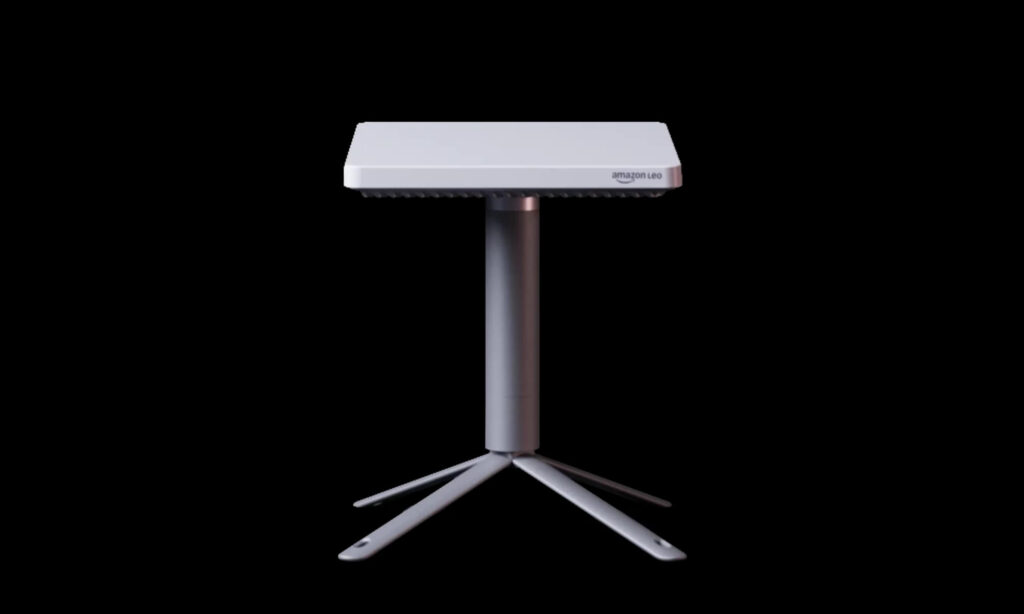
Customers are expected to connect using one of three compact, high-performance antennas—Leo Nano, Leo Pro, and Leo Ultra—each designed to extend high-speed, low-latency broadband to virtually any location on the planet.
Strategic Implications for Digital Inclusion
Satellite broadband could bring reliable internet to millions in rural and underserved regions, unlocking access to education, healthcare, and e-commerce.
Amazon, for instance, has emphasized that its Kuiper network will “deliver high-speed, low-latency broadband to customers worldwide, including communities beyond the reach of traditional networks.”
By leveraging its global logistics infrastructure, Amazon aims to bridge the digital divide for remote villages, businesses, and organizations in places like northern Nigeria, the Niger Delta, and the Middle Belt.
In a global project video to promote the initiative, Director of Technical Program Management at Amazon Kuiper, MiMi Aung, described the mission as ambitious for a truly worthy cause.
“It’s going to impact communities that cannot be reached with fiber or traditional communications,” Aung said, noting “the solution really has to be from space.”
Challenges and Opportunities Ahead
Despite the optimism, several hurdles remain. Affordability is one of them. Satellite broadband services like Starlink currently cost upwards of ₦40,000 ($28.2) per month.
That price point is out of reach for many Nigerians. New entrants will have to square this circle by tackling the affordability issue.
Infrastructure will also have to be ready. Ground stations, power supply, and local distribution networks must be scaled to support widespread adoption. But with Starlink already in operations, the new entrants have a proof of concept on what’s possible.
As oil revenues get pressured and a growing youth population demand digital opportunity, Nigeria’s bet on space-based broadband is both timely and strategic.
With Amazon’s Project Kuiper, BeetleSat, and Satelio’s Iot system set to launch, Nigeria’s digital economy is primed for growth.
If these partnerships deliver on their promise, Nigeria can become a continental leader not just in population and culture, but in digital infrastructure.