
Almultaqa Orchestra Stages an Afro-Arab Identity




Led by Maestro Ahmad Shamma, Almultaqa performs in modular formats designed to adapt to different spaces while preserving its sonic assets.
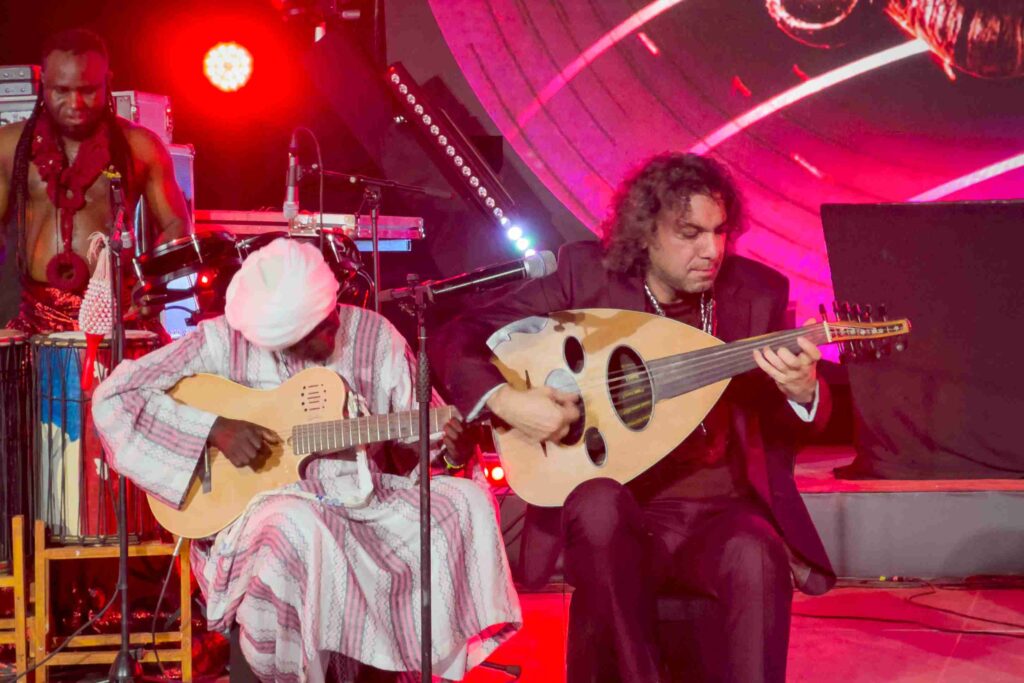
Maestro Ahmad Shamma (on the far right) with his oud flanked by fellow musicians during their performance at the 10th anniversary edition Nyege Nyege Festival held last November in Uganda. Photographer: Samuel Okocha/Maarifaah
By Samuel Okocha
How do Sudanese melodies fused with Malian kora, Nigerian percussion and an Iraqi oud sound?
The answer is not easy. And that’s precisely the point.
As the rhythms of Nyege Nyege Festival shook the banks of the Nile last November, a 30-piece orchestra delivered a sound that defied easy labels.
On stage was Almultaqa Orchestra, an Afro-Arab cultural collective where Africa and Arabia meet through music.
Off stage, ahead of one of their performances, Biroo Hasan, the group’s events and digital manager, explained what Almultaqa represents, especially at a moment when “African music” is increasingly packaged and exported to the world in narrow, seemingly marketable forms.
“It’s me, Biroo, representing Almultaqa Orchestra,” he began, as I adjusted my recorder and try to find a good balance for the interview.
“Almultaqa is an Afro-Arab orchestra. This is the main identity of this orchestra.”
Originally founded in Sudan and later supported by DAL Group, one of the country’s largest conglomerates, Almultaqa once grew to nearly 100 musicians. The war fractured that scale, scattering its members, and forcing the orchestra into partial exile.
Today, around 30 remain active, with 15 musicians relocated out of the conflict zone so the orchestra can continue operating and rebuilding.
Almultaqa, now based in Dubai, has evolved into a transnational cultural collective, performing on international stages while carrying the weight of displacement, memory and continuity.
That said, what remains unchanged is the core idea behind the project: Sudan as a cultural bridge between Africa and the Arab world.
Afro-Arab, by Design
Sudan’s geography and history have always resisted simple categorisation.
To many Arabs, Sudanese people are seen as “too African.”
To many Africans, their use of Arabic makes them “less African” than West African or Bantu-speaking neighbours. Almultaqa does not attempt to resolve that tension. It centres it.
“Sudanese people speak Arabic, so some Africans don’t see them as 100 percent African,” Biro explained.
“And the Arabs, they see Sudanese people as Africans—they’re not Arabs. Sudan has a huge part influenced by West Africa and another side influenced by the Gulf and the Arab region. It’s a mix of two identities at the same time.”
That philosophy shapes not only the orchestra’s identity, but its structure.
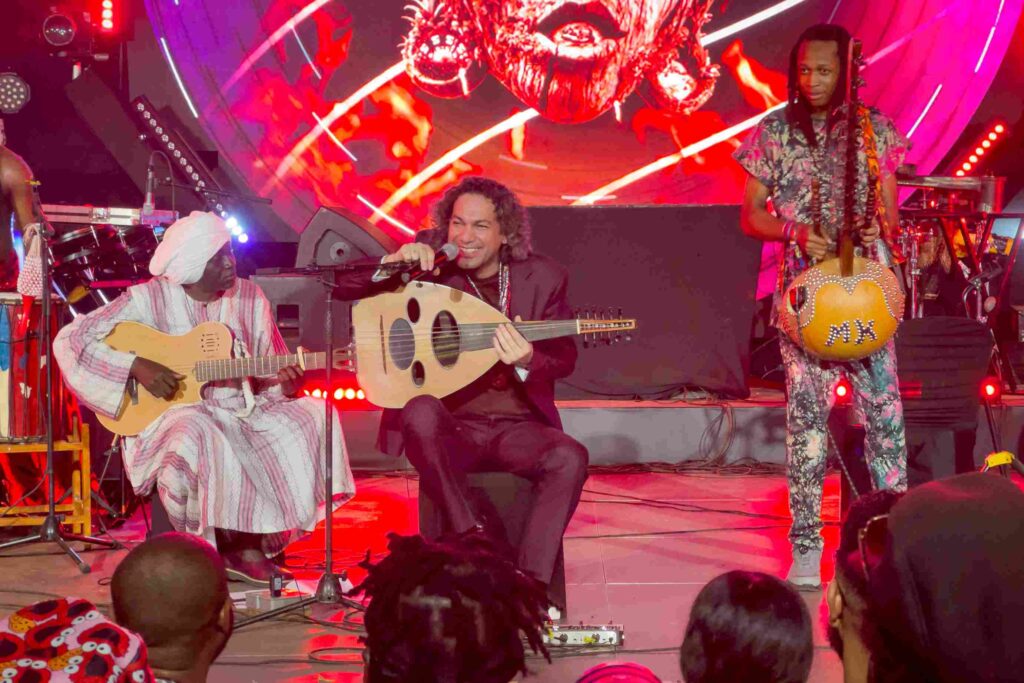
Led by Maestro Ahmad Shamma, Almultaqa performs in modular formats designed to adapt to different spaces while preserving its sonic intent.
The group presents its music either as a seven-member septet or an eleven-member ensemble, scaling intimacy or power depending on the stage.
At the centre of both formats is what the collective calls its “Brink” sound. It’s a meeting point between Sudanese, Afro-Arab and Western traditions.
Rare instruments like the gugay, kora, adungu and balafon sit alongside oud, trumpet and layered African rhythms, creating music that feels both ancestral and contemporary.
The expanded ensemble builds on that foundation, adding electric and acoustic guitars, bass and drums for a fuller, immersive sound. The goal, Biroo explained, was not fusion for novelty’s sake, but reimagined heritage.
A Geography You Can Hear
Almultaqa’s line-up makes its philosophy visible and audible.
About half of the musicians are Sudanese. The conductor and oud player, Ahmad Shamma, is Iraqi. Two musicians came from Mali, one on kora and another on balafon. The percussionist is Nigerian. The trumpet player is Cameroonian—discovered unexpectedly under a bridge in Dubai, playing the Sudanese national anthem on the street.
“Our co-founder was in a car and suddenly she heard the Sudanese national anthem played on a trumpet in Dubai,” Biroo recalled.
“She found this guy from Cameroon, took his number—and one month later, he was in the orchestra.”
At Nyege Nyege, audiences heard echoes of funk, Afrobeat, electronic music and traditional chant, but nothing settled neatly into a single genre. Instead, listeners recognised fragments of themselves.
“People came to us and said, ‘We hear funk, but this is not funk,’” Biroo said. “Or ‘We hear EDM with Afro, but everything is acoustic.’
“Everyone takes the output based on their own references and their own culture. A Malian will lock onto the Malian parts. A Nigerian will hear his culture there. That is exactly what we are trying to present.”
In a global music economy eager to label, simplify and export “African sound,” Almultaqa Orchestra offers complexity as harmony. It stages identity as layered, unresolved and shared.
At Nyege Nyege, a festival known for pushing sonic boundaries, the orchestra’s performances helped in maping a cultural geography where Africa and Arabia are not opposing ideas, but overlapping ones, held together by rhythm, memory and survival.