
Tanzania Secures $2.33 Billion to Finish Indian Ocean-to-Lake Railway as EU, China Vie for East Africa Trade




European and Chinese export credit agencies bankroll final 679 km of Tanzania Standard Guage Railway, embedding their supply chains in a corridor key to coffee, cocoa, and mineral exports.
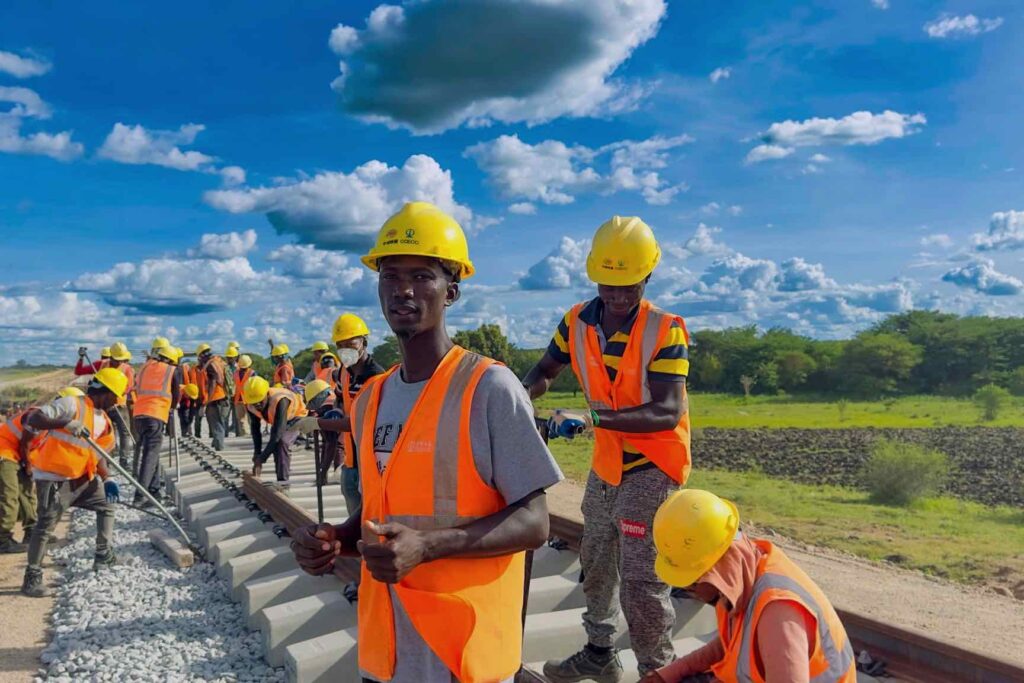
By Samuel Okocha
Tanzania’s push to become the premier logistics gateway for the Great Lakes region got a boost after the East African country secured more than $2.33 billion in multi-national backing to complete a major railway stretching from the Indian Ocean to Lake Victoria. The deal that ties European and Chinese industrial interests directly to East Africa’s trade routes.
Standard Chartered arranged the syndicated financing, announced Tuesday, April 28, 2026.
The funds will pay for 679 kilometers of new Standard Gauge Railway (SGR), closing the final gap in a 1,600-km corridor connecting Dar es Salaam to Mwanza and onward to Rwanda, Burundi, Uganda, and the Democratic Republic of Congo.
Once completed, the 160 km/h electrified line is expected to shift bulk cargo from road to rail across East and Central Africa, linking Mwanza on Lake Victoria to Dar es Salaam and giving Rwanda, Burundi, Uganda, and eastern DRC their first direct rail route to the Indian Ocean.
Turkish contractor Yapi Merkezi will build Lots 3 and 4, a 430 km line from Makutupora to Isaka, backed by $1.78 billion. That package includes $1.32 billion in insurance from Export Credit Agencies (ECAs) in Sweden, Poland, and Italy, signed in 2025 and 2026, plus $462 million in long-term loans from commercial banks and development finance institutions signed in 2023.
China Civil Engineering Construction Corporation will deliver Lot 5. The 249 km from Isaka to Mwanza is financed by a $559 million facility covered by Sinosure, China’s ECA, drawn in 2025.
Standard Chartered acted as sole global coordinator and lead arranger for Tanzania’s Ministry of Finance on both deals. The bank played the same role for the $1.46 billion financing of Lots 1 and 2 in 2020.
As one of Tanzania’s largest infrastructure projects, the SGR is designed to take freight off congested roads, cut transport costs, speed up exports, and open interior regions to investment.
“We are excited for this railway project to position Tanzania as a premier logistics hub, boosting regional trade and job creation,” said Herman Kasekende, CEO of Standard Chartered Tanzania, in a statement Tuesday, April 28, 2026.
The financing comes as Europe and China compete for East Africa’s markets.
Total trade between the EU and the East African Community reached €8.1 billion in 2025, up 28.4% from 2024. The EU is the EAC’s second-largest export market after the UAE, buying coffee, cut flowers, tobacco, cocoa beans, avocados, gold, and fish fillets. It sells machinery, appliances, chemicals, foodstuffs, and wood products back to the region.
China is also working to deepen trade. As of May 1, 2026, Beijing implemented zero-tariff treatment on 100% of imports from 53 African nations with diplomatic ties, running through April 30, 2028.
The policy covers agricultural goods, raw materials, and manufactured products. It aims to boost African exports and correct trade imbalances. In 2025, Africa’s trade deficit with China grew $102 billion, up 65%, a gap Beijing wants the railway to help close with more goods moving to port.
The SGR ties into that mix of global interests. European ECAs backed Lots 3 and 4 while China covered Lot 5, a financing split that seemingly follows the division of construction between Turkish contractor Yapi Merkezi and China’s CCECC.
The deal also advances the Mattei Plan, Rome’s new Africa strategy anchored on mutually beneficial partnerships in the continent’s industrial growth.
“This achievement reflects SACE’s strong commitment to strengthen and promote the Italian supply chain, positioning Italian companies as key partners in Africa’s connectivity and economic growth, the core objectives of the Mattei Plan,” said Ciro Aquino, Head of Task Force Africa at SACE.
Italy’s SACE and Sweden’s EKN are returning to the project. Both agencies helped insure the $1.6 billion financing for Lots 1 and 2 in 2020. Their new commitments for Lots 3 and 4 extends that partnership.
“This investment demonstrates the critical importance of international cooperation and leveraging the potential of financial institutions from various countries to deliver a meaningful, large-scale positive impact on people’s lives in Africa,” said Janusz Władyczak, CEO of Poland’s KUKE, which joined SACE and EKN in the latest facility.
With Lots 1 and 2 already running 722 km from Dar es Salam to Makutupora, construction on Lots 3, 4, and 5 will close the final 679 km gap to the Mwnaza on the southern shore of Lake Victoria.
The full Dar-to-Mwanza line is expected to shift bulk cargo that include minerals, coffee, tea, and fuel from trucks to rail, easing pressure on Tanzania’s road network and cutting emissions.
With the Tanzania Rail Corporation overseeing development, the government is betting on the SGR to drive industrialization and take market share from Kenya’s Mombasa, positioning Dar es Salaam as the international trade gateway for Rwanda, Burundi, Uganda and eastern DRC.