
Chariot is Raising $20 Million to Enter Angola Oil Sector




London-listed energy firm backs Etu Energias in acquiring producing offshore assets, with Shell providing $170 million in financing.
By Samuel Okocha
Chariot Plc, the London‑listed energy company focused on Africa, is raising $20 million through an equity placing and subscription, alongside an open offer of up to $4 million, to finance entry into Angola’s upstream oil sector.
The fundraising will issue about 1.13 billion new shares at 1.4 pence each, with proceeds earmarked to part‑finance the acquisition, cover transaction costs and provide working capital.
Chief Executive Adois Pouroulis said the placing was oversubscribed, highlighting investor appetite to the company’s pivot toward production.
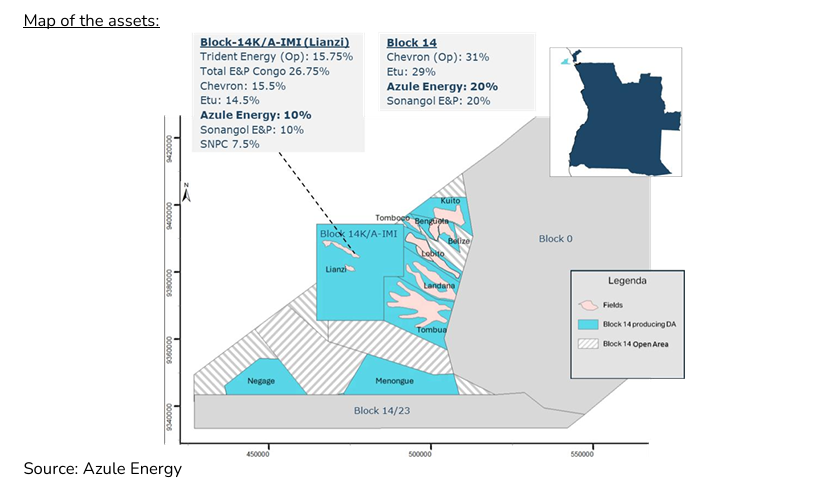
The company is backing Angola’s state‑owned Etu Energias in its purchase of a working interest in offshore Blocks 14 and 14K, which produce around 8,000 barrels a day.
Chariot’s funding entitles it to economics equivalent to up to 4,000 barrels a day. Shell Western Supply and Trading is providing as much as $170 million in acquisition financing in exchange for future offtake barrels.
The transaction marks Chariot’s first exposure to producing assets, a strategic shift from exploration toward cash‑generating barrels.
As part of that repositioning, Chariot, which also has interests in Morocco and Namibia, plans to spin off its renewable energy and green hydrogen activities into a separate company, leaving the listed entity to concentrate on upstream oil and gas.
“This marks a strategic first step into Angola’s oil sector for us,” Chief Executive Adonis Pouroulis said in an official statement.
“We very much look forward to finalising this transaction as well as future opportunities that this collaboration could unlock.”
International majors have been retreating from certain upstream positions, prioritizing balance‑sheet repair and lower‑carbon portfolios.
Their exit has created entry points for smaller operators willing to assume operational complexity in exchange for discounted acquisition terms.
The Chariot Angola oil deal aligns with that pattern, shifting strategy toward cash‑generating production rather than high‑risk exploration.
Oil Production and Angola Positioning
Angola, Africa’s second‑largest oil producer, has been seeking to attract investment since leaving OPEC in December 2023 after disputes over production cuts.
Output has fallen from a peak of 1.8 million barrels a day in 2014, but reforms and licensing adjustments are aimed at extending the life of mature fields and bolstering investor confidence.
“If we remained in Opec… Angola would be forced to cut production, and this goes against our policy of avoiding decline and respecting contracts,” Mineral Resources and Petroleum Minister Diamantino Azevedo said at the time of the decision.
Recent developments highlight both the opportunities and the reshaping of Angola’s upstream sector.
Azule Energy, the joint venture between Italy’s Eni and BP, confirmed the full field start‑up of the Ndungu project in February 2026, with oil flowing from three production wells offshore.
At the same time, Azule has been streamlining its portfolio.
In December 2025, Azule Energy signed a $310 million agreement to divest its stakes in Blocks 14 and 14K to a consortium comprising Maurel & Prom and BW Energy. Azule held a 20% interest in Block 14 and 10% in Block 14K.
Chief Executive Joseph Murphy said the sale was “aligned with Azule Energy’s strategy to concentrate our efforts on our core assets in Angola.”
The combination of new production coming online and asset rotation by larger players underscores Angola’s dual strategy of sustaining output through fresh investment while creating space for independents and smaller operators to take on mature fields.
Chariot’s planned entry into Blocks 14 and 14K ties into into this dynamic, underpinning how the southern African nation is positioning itself to maintain production and attract capital outside the OPEC framework.