
South Africa Joins Afreximbank to Bolster Intra‑African Trade Amid Global Fragmentation




Membership unlocks $8 billion programme as Afreximbank targets doubling intra‑African trade finance by 2026.
By Samuel Okocha
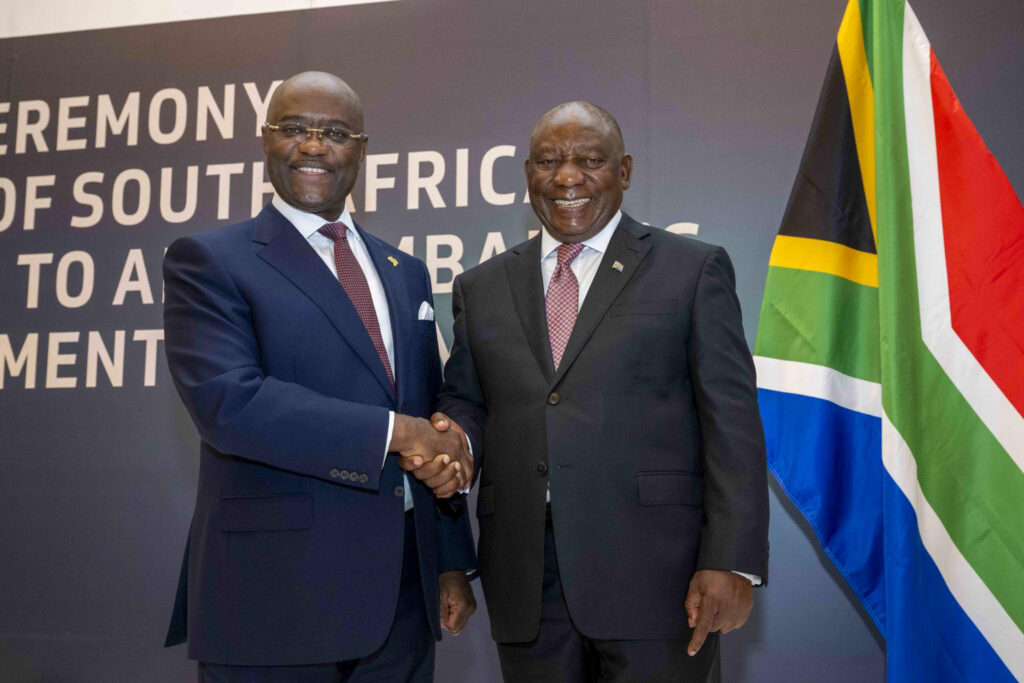
South Africa, the continent’s most industrialized economy, formally became the 54th member of the African Export‑Import Bank (Afreximbank), energizing the growing push to deepen intra‑African trade as global commerce continues to unpredictably fragment.
The accession, approved by parliament in 2025, gives South Africa full access to Afreximbank’s trade finance instruments at a time when exporters face rising uncertainty from shifting global trade policies.
As part of the partnership, the Cairo‑based lender will roll out an $8 billion country programme in South Africa, aimed at supporting the country’s developmental goals, which include eliminating poverty, reducing inequality and boosting youth employment.
The initiative builds on an already robust financing relationship. Afreximbank has said its current project pipeline in South Africa exceeds $6 billion, spanning healthcare, financial services, manufacturing, energy, industrial development, and mining.
“The country programme is aligned with South Africa’s National Development Plan 2030 and national industrial and trade priorities, and targets key strategic areas,” Afreximbank President and Board Chairman George Elombi said in a official statement. South Africa’s entry, he noted, marks “a decisive step toward uniting around the continent’s economic interests.”
AfCFTA Linkages and Afreximbank’s Role
South Africa’s accession also strengthens the institutional foundation of the African Continental Free Trade Area (AfCFTA), which aims to create a single market spanning 54 countries with a combined GDP of more than $3 trillion.
Afreximbank has emerged as a central financier of the bloc, providing trade finance, payment infrastructure, and export development support to bridge gaps left by underdeveloped financial markets. Its Pan‑African Payment and Settlement System (PAPSS), for example, is designed to reduce reliance on hard currencies by enabling cross‑border trade in local currencies.
Despite progress, structural constraints continue to slow integration. According to the Afreximbank African Trade Report 2025, trade integration must be underpinned by stronger financial ecosystems, sustained investment in digital and physical infrastructure, and targeted trade finance for small and medium‑sized enterprises if AfCFTA is to deliver on its promise.
“Only then”, the bank said, “can Africa build regional value chains that move economies away from raw‑commodity dependence toward higher‑value industrial production.”
Scaling Up Trade Finance
Afreximbank disbursed $17.5 billion in 2024 and has set a target to double intra‑African trade finance by 2026. South Africa’s membership is expected to play a critical role in that expansion, given the country’s manufacturing depth, financial sophistication, and role as a gateway for regional trade.
“South Africa’s accession to Afreximbank confirms our commitment to advancing African industrial development and deepening trade, investment and development across the continent,” President Cyril Ramaphosa said.
“This partnership will strengthen in more ways than one South Africa’s ability to support South African exporters, industrial projects and regional value chains while advancing our continent’s progress.”