
Uganda’s Farms Fuel $4.18 Billion Export Surge Ahead of Oil Era




Record coffee exports, rising cocoa and dairy output, and improved irrigation drive sector as the IMF projects GDP to peak at 9.4% by fiscal year 2026/27
By Samuel Okocha
Uganda agriculture exports surged in fiscal year 2024/25, generating $4.18 billion in exports, more than double the $1.66 billion four years earlier, and accounting for 39% of total export earnings, according to government statement.
The sector contributed 26.1% of GDP and grew 6.6%, driven by gains in coffee, cocoa, dairy, and fisheries, amid irrigation expansion and disease controls.
The performance helped narrow the country’s account deficit to 6.1% of GDP, “supported by strong coffee exports,” according to a January 2026 IMF assessment. Foreign exchange reserves also rose to cover three months of import coverage by Ocober 2025, fueled in part by portfolio inflows and robust agricultural earnings.
The results, announced by the Ministry of Agriculture, Animal Industry and Fisheries, highlight farming’s role as a key pillar of Uganda’s economy.
With 70% of households (7.1 million) agriculture-dependent, the surge bolsters household incomes, reduces import reliance and strengthens foreign reserves for debt servicing and currency defense.
The gains reflect “deliberate commitment,” Maj. Gen. David Kasura-Kyomukama, permanent secretary, said in an emailed statement.
“Agriculture is not just Uganda’s backbone; it can be the path to transforming our society from predominantly peasant to a middle-class and knowledge-based one.”
Coffee Hits $2.2 Billion Record
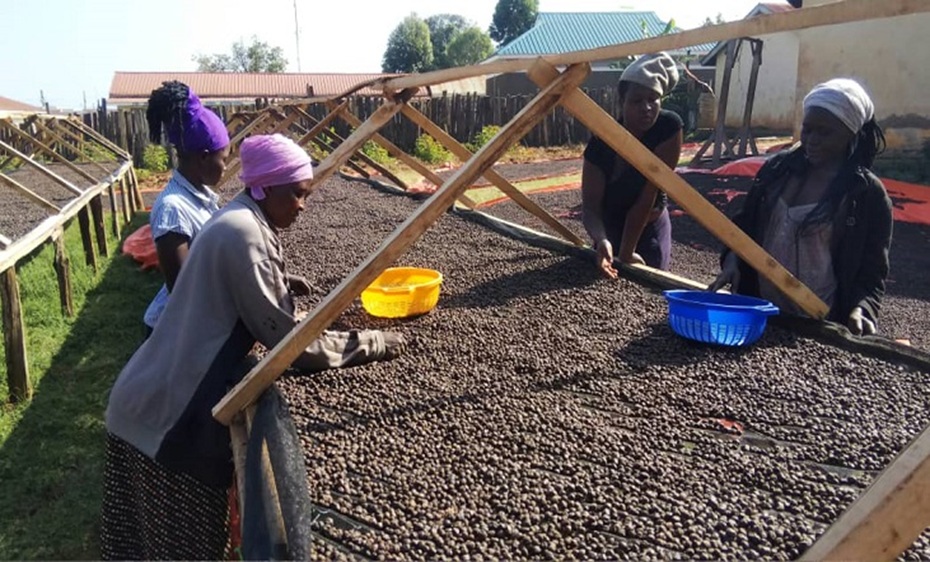
Coffee led the growth, earning $2.2 billion from 8.2 million 60-kg bags exported, the highest volume and value on record. Production rose to 9.3 million bags, up from 7.75 million in 2019/20.
Key interventions contributed to the record growth. Government distributed 85 million seedlings, stumped 15 million old trees and released wilt-resistant varieties yielding up to 3.9 tons per hectare. The number of value-chain actors tripled to 7,477.
Cocoa, Dairy, and Oil Palm Expand
Cocoa exports grew nine-fold to $620 million from $71 million in 2015/16, making it Uganda’s second-largest agricultural export and third overall after gold and coffee. Production reached 76,173 tons, with 72,500 tons exported.
Oil palm production reached 41,000 tons of crude annually across 16,800 hectares, reducing import dependency and generating an average of UGX 500,000 ($135) per acre monthly for farmers after year four.
Dairy output doubled to 5.3 billion liters, while exports tripled to $280 million. Processing capacity now stands at 3.4 million liters daily across 145 licensed plants.
Fisheries and Food Security
Fisheries production rose to 728,369 tons in 2023 from 622,000 in 2021, with beach value climbing to 2.2 trillion shillings ($600 million).
Vaccines, Machines and Dams
The government delivered 19.8 million doses of foot-and-mouth disease vaccine and established cold chain systems in 53 districts, alongside a national facility capable of producing 80 million doses annually. A local anti-tick vaccine plant is also under development to address the estimated $1.1 billion in annual livestock losses.
Mechanization efforts included 1,080 four-wheel tractors, 1,350 power tillers, and training for 2,000 operators. Irrigation infrastructure expanded by 3,576 hectares across eight schemes.
2026 Outlook and Beyond
The ministry’s 2026 agenda includes a fertilizer fund, national tea standards, fish hatcheries, additional mechanization, and the establishment of export zones. A new National Marketing Company and credit guarantee scheme also aim to de-risk trade and improve market access.
The push positions agriculture as a springboard in Uganda’s industrialization drive, blending exports with rural uplift amid AfCFTA opportunities.
According to the IMF, Uganda’s budget deficit widened to 6% of GDP in FY2024/2025, up from 4.7% the previous year, pushing public debt to 52.4% of GDP as efforts to rebuild the fiscal space lagged.
Still, the Fund, expects macroeconomic conditions to remain favourable, with real GDP growth, already at 6.3% in FY24/25, projected to peak at 9.4% in FY2026/27, driven in part by oil production slated to begin in late 2026.