
South Africa Inflation Accelerates on Fuel Costs as Energy Transition Shapes Outlook




Energy‑linked price pressures drive April’s jump, while reforms and renewables reshape the country’s inflation outlook.
By Samuel Okocha
South Africa’s inflation accelerated in April as higher fuel prices pushed up transport and logistics across the economy.
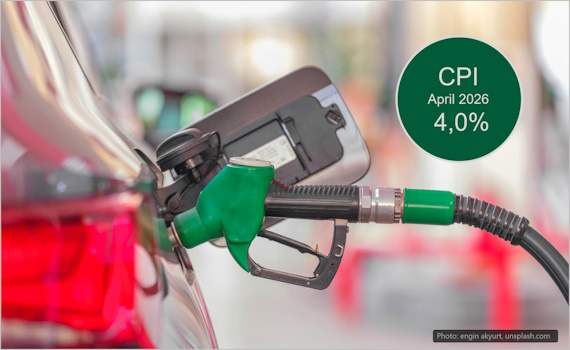
Annual consumer prices rose to 4.0% in April, up from 3.1% in March, reaching the highest level since August 2024, as the conflict in Iran lifted global energy prices, Statistics South Africa said on Wednesday. A weaker rand also made imports costlier.
Fuel prices jumped 18.2% from the previous month, the steepest rise since 2008, while passenger transport services climbed 3.1%, the biggest increase since mid‑2022.
On the other hand, not everything got more expensive. According to StatsSA, annual inflation for food & non-alcoholic beverages (NAB) actually slowed for the third month in row, decreasing from 3.6% in March to 2.9% in April.
That suggests the latest squeeze is concentrated in energy‑linked categories rather than the larger consumer basket.
Power stability offers buffer against South Africa inflation fragility
The outlook remains fragile given South Africa’s reliance on imported fuel. If the Iran conflict drags on oil, analysts warn transport, freight and consumer prices could remain elevated in the months ahead.
Meanwhile, a more stable electricity supply could act as a buffer against inflation. On May 16, South Africa’s state power utility Eskom said the country has gone 365 consecutive days without power interruptions, reducing the need for costly diesel generation or load shedding that usually pushes cost for businesses and households.
That power stability follows years of crisis when aging coal plants, as at 2023, left nearly half of Eskom’s generation capacity offline.
Reforms to utility operations and the opening of markets to private generation have helped restore reliability. The country plans to retire between 8GW and 12GW of coal‑fired capacity over the next decade, while scaling up renewables.
South Africa is already leading Africa’s solar rollout. The Global Solar Council reports the continent recorded its fastest year of solar growth in 2025, with installations rising 54% year‑on‑year. South Africa added 1.6 GW, the largest share among African markets.
Private developers are also reshaping the landscape. SOLA recently achieved financial close on Naos‑1, a 300 MW solar PV and 660 MWh battery storage project in the Free State province, designed to deliver firm, dispatchable renewable power to private off‑takers.
This week, Eskom told Reuters it as entered exploratory talks with the World Bank over funding for a multibillion-dollar nuclear programme, amid search for new baseload power to complement the shift away from coal.